
AutoPartsChecker: https://autopartschecker.com/toyota/camry/2020/
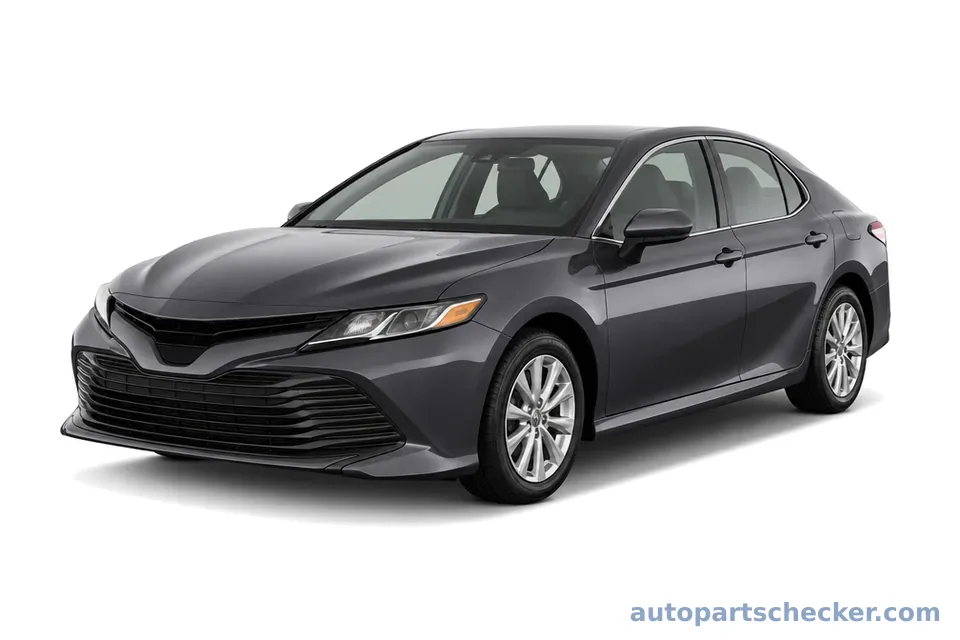
2020 Toyota Camry common problems
Owners have filed 287 complaints with NHTSA about this vehicle.
The most common problem area is electrical system: 68 complaints (24% of all), typically reported around 5,000 miles. Next is engine (60).
3 recalls listed by NHTSA for this vehicle.
278 service bulletins sent by the manufacturer to dealers.
Updated: Recalls, bulletins and complaints updated daily. Request alerts for your vehicle
Problems by area
Select an area to read the complaints.
Safety ratings: 5 stars overall
| Version tested | Overall | Front | Side | Rollover |
|---|---|---|---|---|
| 2020 Toyota CAMRY 4 DR AWD | ★★★★★ | ★★★★★ | ★★★★★ | ★★★★★ 9.9% risk |
| 2020 Toyota CAMRY 4 DR FWD | ★★★★★ | ★★★★★ | ★★★★★ | ★★★★★ 9.9% risk |
| 2020 Toyota CAMRY HYBRID 4 DR FWD | ★★★★★ | ★★★★★ | ★★★★★ | ★★★★★ 9.9% risk |
NHTSA 5-star crash tests for this model year, by the versions NHTSA tested; more stars are safer. The rollover percentage is NHTSA's estimated chance of a rollover in a single-vehicle crash.
Fuel economy: 25–52 MPG combined
| Version | City | Highway | Combined |
|---|---|---|---|
| Camry Hybrid LE 2.5L 4-cyl, Hybrid, Automatic (AV-S6), Front-Wheel Drive | 51 | 53 | 52 MPG |
| Camry Hybrid XLE/SE 2.5L 4-cyl, Hybrid, Automatic (AV-S6), Front-Wheel Drive | 44 | 47 | 46 MPG |
| Camry 2.5L 4-cyl, Automatic (S8), Front-Wheel Drive | 29 | 41 | 34 MPG |
| Camry LE/SE 2.5L 4-cyl, Automatic (S8), Front-Wheel Drive | 28 | 39 | 32 MPG |
| Camry XLE/XSE 2.5L 4-cyl, Automatic (S8), Front-Wheel Drive | 27 | 38 | 31 MPG |
| Camry AWD LE/SE 2.5L 4-cyl, Automatic (S8), All-Wheel Drive | 25 | 34 | 29 MPG |
| Camry AWD XLE/XSE 2.5L 4-cyl, Automatic (S8), All-Wheel Drive | 25 | 34 | 28 MPG |
| Camry 3.5L 6-cyl, Automatic (S8), Front-Wheel Drive | 22 | 33 | 26 MPG |
And 2 more versions.
EPA fuel economy estimates (fueleconomy.gov). Your mileage will vary with driving, weather and upkeep.
New owner complaints
3 new complaints added by NHTSA since October 29, 2026, newest first. Complaints are unverified reports from owners.
Received by NHTSA November 14, 2026, crash, 1 injured. Seat belts
The seat belt malfunctioned
Received by NHTSA November 13, 2026. Electrical system
Vehicle purchased brand new in April 2020. June 1, 2020, battery needed a jump. No new battery needed. Oct 23, 2023, battery needed a jump, new battery needed. June 27, 2024, car did not start, unable to jump battery. Needed alternator and new battery. Dec 28, 2024, battery needed a jump. No new battery needed. Aug 3, 2026, battery needed a jump, new battery needed.
Received by NHTSA November 3, 2026. Unknown or other
My Toyota Camry 2020 with approximately 104,000 miles developed a progressive transmission problem beginning in September 2026. When accelerating, the vehicle experiences a significant lag and struggles between first and second gear. The problem started intermittently about two months ago and has steadily worsened. In September 2026 I took the vehicle to a shop for an engine and transmission fluid service. I was told no problems were found. A few weeks later the hesitation and lag became severe. On one occasion the vehicle would not accelerate at all when I pressed the gas pedal. I had…
NHTSA complaint 11775534: read the full complaint
Past NHTSA investigations
DP22005: Pedestrian alert sounds. Defect petition, closed August 7, 2023, led to recall 22V063.
Recalls
Recall 23V865, Dec 2023: Airbags
A short circuit may develop in the Occupant Classification System (OCS) sensor, preventing the front passenger air bag from deploying.
Recall 20V682, Nov 2020: Fuel system (gasoline)
The low-pressure fuel pump inside the fuel tank may fail.
Recall 20V064, Feb 2020: Engine and cooling
Toyota Motor Engineering & Manufacturing (Toyota) is recalling certain 2020 Toyota Avalon Hybrid, Camry, Camry Hybrid and Lexus ES300h and 2019-2020 RAV4 and RAV4 Hybrid vehicles equipped with 2.5L 4-Cylinder engines.
Technical service bulletins
Emissions 26TF01, Sep 2026: Fuel system
Under certain conditions, debris can accumulate inside the fuel cap causing potential fuel vapor leaks that can cause increased evaporative emissions to exceed the regulated limits. This issue will not trigger the M.I.L. (Malfunction Indicator Lamp)
Service bulletin T-SB-0110-20 Rev2, Aug 2026: Engine
OBSOLETE NOTICE August 20, 2026: This bulletin is now obsolete. Please see T-SB-0051-26.
Service bulletin T-SB-0051-26, Aug 2026: Engine
This bulletin includes basic procedures for performing a rescue charge at battery on high voltage (HV) Ni-MH and Li-ion batteries.
Parts guide
Brakes
- Brake Pads Few complaints mention it
- Brake Rotors Few complaints mention it
- Brake Calipers Few complaints mention it
Suspension & Steering
- Struts & Shocks Few complaints mention it
- Control Arms Few complaints mention it
- Wheel Hub Bearings Few complaints mention it
- CV Axles Few complaints mention it
Engine & Electrical
- Alternator Few complaints mention it
- Starter Few complaints mention it
- Ignition Coils Few complaints mention it
- Spark Plugs Few complaints mention it
- Oxygen Sensor Few complaints mention it
- Fuel Pump 20 owner complaints mention it
Cooling & Belts
- Radiator Few complaints mention it
- Water Pump Few complaints mention it
- Serpentine Belt Few complaints mention it
Lighting & Body
- Headlight Assembly Few complaints mention it
- Tail Light Assembly Few complaints mention it
- Side Mirror Few complaints mention it
Filters
- Cabin Air Filter Few complaints mention it